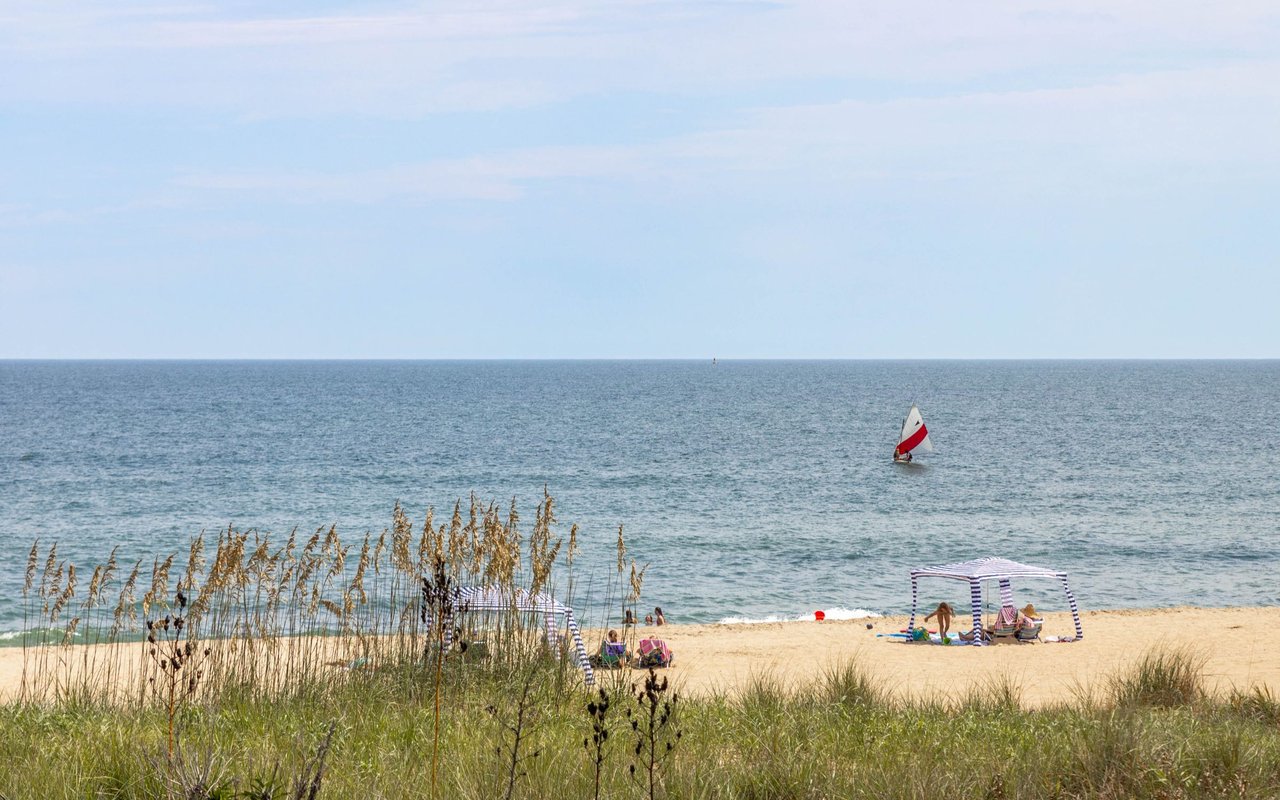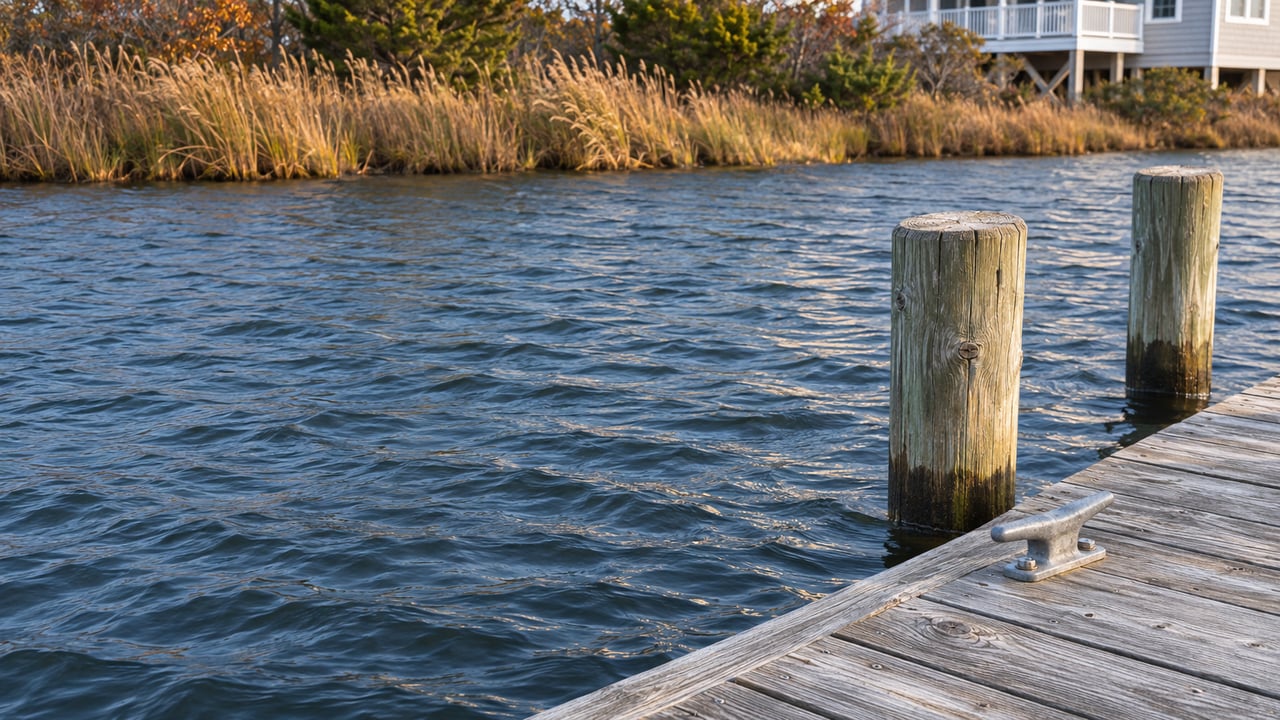
How much water was under that dock on the day you toured the house? On a Sandbridge Shores canal, the honest answer is "whatever the wind allowed that afternoon." Buyers who grew up boating on tidal water assume the depth they saw at a showing will come back twice a day like clockwork. In Back Bay, it won't.
That matters most for the buyer who pictures a boat tied up out back. A canal-front listing in Sandbridge Shores sells two things together: the house, and access to the bay. The house can be inspected. The access depends on two facts that never show up on a listing sheet. The bay's water level rises and falls with the wind, not the moon. And no city program currently has the job of keeping these canals deep.
The water at the dock is a weather reading
Back Bay was cut off from the ocean long ago. Virginia's Department of Conservation and Recreation describes the marshes of Back Bay and the nearby Currituck Sound tributaries as systems that "are no longer influenced by lunar tides." Instead, wind-driven currents can move water levels by as much as 1 meter, or about 3 feet, according to DCR's description of wind-tidal marshes.
The direction of the wind decides which way the water moves. The City of Virginia Beach's Back Bay marsh restoration page explains that sustained southerly winds push water up from Currituck Sound into Back Bay. Turn that around and you get the case canal owners care about most. A 2022 fishing account in Woods & Waters Magazine describes the pattern in plain terms: southerly winds push water in, northerly winds blow it out. The writer recalls the bay dropping about six inches overnight.
For a buyer, that changes what a showing tells you. A dock seen after a few days of south wind can look like it has plenty of water. The same dock after a steady north wind has less, and a tide chart can't predict which day you'll get. The depth you saw is real. It's a snapshot of one weather pattern, not a fixed feature of the lot.
What the bay allows to begin with
Wind is only part of it. The bay itself is shallow. NOAA's Coast Pilot 4, the federal navigation guide for this stretch of coast, calls Back Bay "a shoal bay navigable only by small boats." It adds that Shipps Bay and North Bay, at the bay's northern end, are shallow too.
The agencies that run the public water around Sandbridge plan for the same conditions. The False Cape State Park page says only experienced boaters familiar with Back Bay should try reaching the park by water. It warns that "shifting winds can dramatically affect water depth and navigation, making it unsafe for many boaters." The park also charges a fee to bring out boats whose owners can't paddle them out. Back Bay National Wildlife Refuge offers a soft launch for kayaks, canoes and small hand-carried boats. Its boating page says it has no launch facilities for large motorboats and doesn't allow trailers at its launches.
None of these sources sets a depth limit for a private Sandbridge Shores canal. They do describe the water every Sandbridge Shores boat has to cross. A canal lot works best for the boat the bay was built for: shallow draft, light and small. If the boat in your plans draws more water, the wind will decide some of the days it can leave the dock.
No channel on the city's list
If the bay and the wind set the water level, the canal bottom sets the rest. That brings up a question few canal buyers ask: who keeps the bottom where it is?
Virginia Beach does maintain some channels. Its neighborhood dredging program page lists City-maintained channels in the Lynnhaven branches, Crab Creek, Long Creek, Keeling Drain, Rudee Inlet and Lynnhaven Inlet. The Sandbridge Shores canals and Back Bay aren't on that list.
For neighborhood waterways, the City Council created the Neighborhood Dredging Program in 2011. It works as a Special Service District, which means waterfront owners in a defined area agree to pay an extra charge on their real estate taxes to fund dredging of their own channel system. Here is how the city describes it:
- A neighborhood that wants to explore a district asks for a community workshop, where city staff explain the proposal and gauge support.
- Most special service districts need more than 50% of owners to sign a willingness petition. For dredging districts, City Council raised that threshold to 80%.
- If support reaches 80%, staff prepare an ordinance, and City Council holds a public hearing before adopting it.
- The dredging removes built-up sand and silt from existing waterways. It doesn't create new channels or widen existing ones.
The costs fall into three tiers:
| Piece of the channel system | Who pays, per the city |
|---|---|
| Short spur from the nearest City-maintained channel to the neighborhood channel | The City |
| The neighborhood channel system, including design, permitting and monitoring | District tax revenue paid by participating owners |
| The individual channel from a private dock to the neighborhood channel | The owner who wants to connect |
Eight districts exist today: Schilling Point, Hurds Cove, Gills Cove, Harbour Point, Chesopeian, Shadowlawn, Bayville Creek and Old Donation Creek. None is in Sandbridge. The program also describes the city's share as a spur that connects to an existing City-maintained channel, and Back Bay has none on the city's list.
Put those pieces together and the economics of a Sandbridge Shores canal lot come into focus. If the canals ever needed deepening through the city program, the owners would be the ones paying, and four in five of them would have to agree first. Any dredging in open water and wetlands also goes through state and federal review. Virginia's Department of Environmental Quality says that work is regulated through the Joint Permit Application process, coordinated with the Army Corps of Engineers and the Virginia Marine Resources Commission. The depth at your dock is something you inherit with the property. No public agency is on the hook to restore it.
That puts the canal in the same category as the bulkhead. It's part of the property's condition, and the costs and decisions run through you and your neighbors. Those neighbors' willingness counts as much as your own.
Checking the water before you write an offer
Since depth depends on the weather and maintenance depends on the owners, a buyer has to measure it on purpose. A practical sequence:
- Look up the bay's level on the day you visit. NOAA's National Weather Service publishes a gauge called Back Bay at Back Bay Landing, BBLV2. The City of Virginia Beach provides the data, and it's reported as stage against a gauge zero tied to the NAVD88 datum. Note the reading on the day you see the dock, so you know whether you saw the water high, low or somewhere between.
- See the dock after a north wind. Since northerly winds blow water out of the bay, a second visit after a few days of steady north wind shows you something close to the lot's worst ordinary case.
- Sound the slip and the path to the main canal. What counts is the depth at the dock and every foot of water between the dock and the main canal. Under the city's dredging model, that dock-to-channel stretch is what a private owner pays for.
- Match the boat to the bay. Compare your boat's draft with the low reading, not the high one, and keep in mind that the Coast Pilot calls Back Bay navigable only by small boats.
- Ask the seller what they know. Ask about any past dredging of the slip or canal, which permits covered it and who shared the cost. Then read that history alongside the bulkhead's permit year.
A lot that keeps usable water at its north-wind low is worth more to a boating household than one that only looks good after a south wind, even when the two listings read the same.
Questions canal buyers ask
Can I use a tide table to plan boat trips from Sandbridge Shores?
Not for Back Bay. DCR describes the bay's marsh systems as no longer influenced by lunar tides, with wind driving changes of up to about 3 feet. The BBLV2 gauge and the wind forecast tell you more than a tide table.
Does the city dredge canals in Sandbridge?
The city's maintained-channel list doesn't include the Sandbridge Shores canals or Back Bay. Its Neighborhood Dredging Program has eight districts, none of them in Sandbridge. Forming a new district takes 80% owner support, a council public hearing and a special tax on participating properties.
Can a larger powerboat get out into the bay?
The refuge has no launch facilities for large motorboats. State park guidance warns that shifting winds can make Back Bay unsafe for many boaters. Draft and the day's wind decide it, so the north-wind check above matters most for bigger boats.
This post is general information about how the city's dredging program and state permitting work. It isn't legal, tax or financial advice, so please confirm the details of any specific property or proposal with the City, the permitting agencies or your own attorney.
If you're weighing a Sandbridge Shores canal home and want to see a dock at its low water before you commit, Sandbridge Life can help you time that visit, ask the seller the right questions about the slip and canal, and factor what you learn into your offer. Get in Touch.