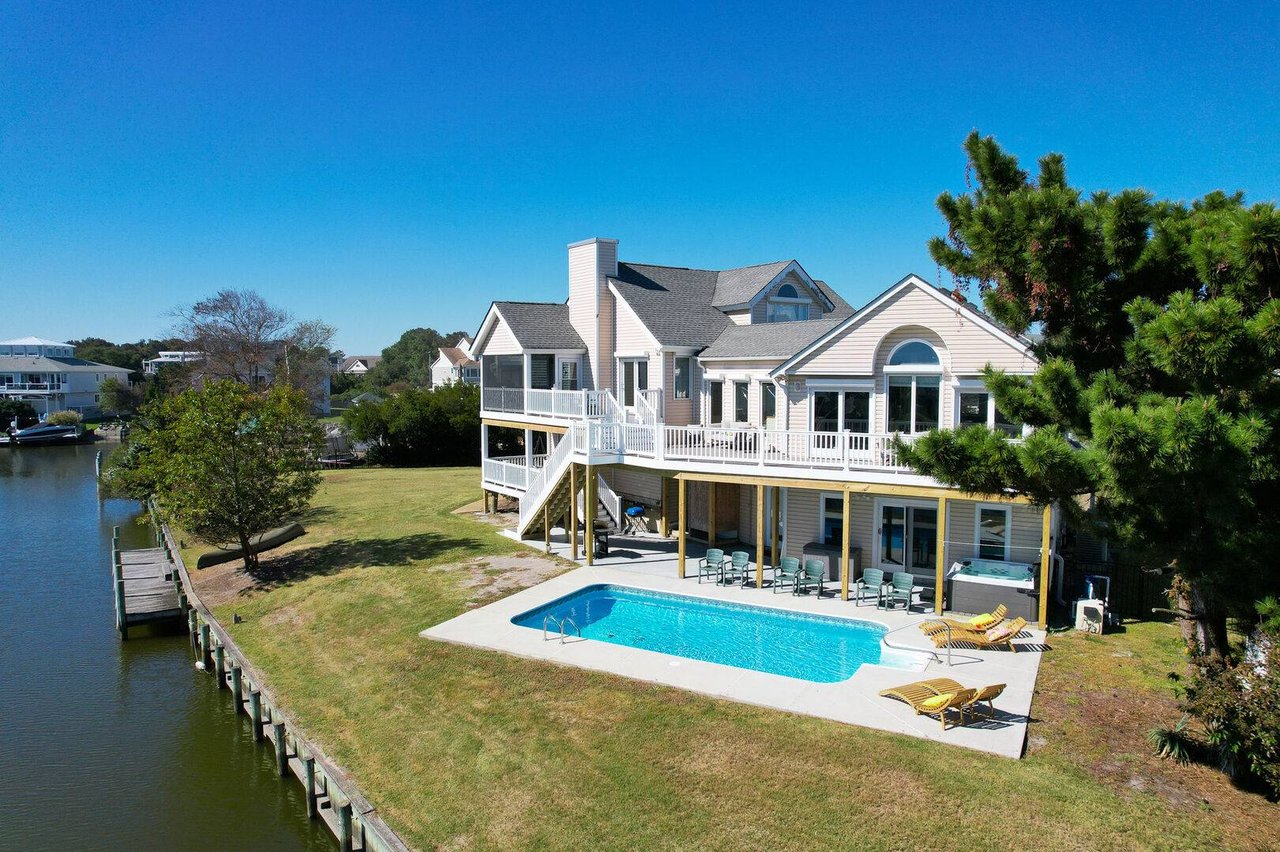
In February 2026, Virginia Beach Wetlands Board staff reviewed a bulkhead on Bass Inlet West, behind a home on Wood Duck Drive. The board had approved that wall and its boat ramp in November 2001. The February 2026 staff report described it as "approximately 25 years old, which is consistent with the lifespan of a timber bulkhead," and noted that "pockets of erosion" were forming behind it.
A month earlier, the same board reviewed another Wood Duck Drive lot on the same canal. That bulkhead had been approved on September 13, 2004, and the January 2026 staff report said it was "reaching the end of its construction lifespan and showing signs of deterioration."
Both owners applied to replace their walls with vinyl. The approval dates are public record.
The age of the wall is on file with the city
Each Wetlands Board staff report includes a permit history for the property, giving the date of earlier approvals. One Wood Duck Drive report shows the 2001 approval, and the other shows the 2004 approval.
A regional cost guide from 757 Waterfront, updated October 2026, says pressure-treated wood typically lasts roughly 15 to 25 years in salt water. Vinyl sheet piling, now the most common choice for saltwater homes, commonly lasts 50 years or more. The two Wood Duck Drive walls fall right at the end of that wood range.
The same pattern runs through Sandbridge's other man-made canals that connect to North Bay:
Hearing | Street | Waterway | Proposal | Staff's stated reason |
|---|---|---|---|---|
Jan. 2024 | Sand Bend Road | Bass Inlet | 100 ft bulkhead plus returns | Unprotected, eroding shore |
Aug. 2024 | Sandpiper Road | Bass Inlet | 81 ft bulkhead plus two 10 ft returns | Unprotected, eroding shore |
Nov. 2025 | Little Island Road | North Bay Inlet | 92 ft bulkhead, 2 ft channelward | Existing wall deteriorating |
Nov. 2025 | Whiting Lane | North Bay Inlet | 183 ft bulkhead, 2 ft channelward | Existing wall deteriorating |
Jan. 2026 | Wood Duck Drive | Bass Inlet West | 120 ft vinyl, 2 ft channelward | End of lifespan |
Feb. 2026 | Wood Duck Drive | Bass Inlet West | 99 ft vinyl plus two 11 ft returns | About 25 years old, failing |
The records are in the city's monthly staff reports for January 2024, August 2024 and November 2025, along with the two 2026 reports. The 2024 Sand Bend Road and Sandpiper Road cases involved shoreline with no wall at all. The Little Island Road, Whiting Lane and Wood Duck Drive applications proposed replacing worn-out walls, each with a new wall up to 2 feet in front of the old one.
Bulkhead applications in recent cases
City and state information and recent Sandbridge Shores canal applications offer these details:
- Application submission. The Virginia Marine Resources Commission lists the U.S. Army Corps of Engineers' Regulatory Request System as the central submission point as of September 1, 2025. According to the city's Wetlands Board page, applications then go to the Corps, VIMS, DEQ and the city for review.
- Listed fees. The city lists $230 for waterfront construction and $450 for projects that affect wetlands.
- Mitigation in two applications. Both Wood Duck Drive applications proposed buying credits from the Virginia Stream and Wetland Mitigation Program to offset impacts to the canal bottom and wetlands. One applicant had already received a letter confirming credits were available.
Living shorelines in recent canal cases
Virginia law names living shorelines as the preferred way to stabilize tidal shoreline.
In every Sandbridge canal case in the table, the applicant's agent argued a living shoreline would not work, and staff accepted that reasoning. The reasons depended on the property:
- The 2004 wall on Wood Duck Drive: the height of the existing bulkhead, existing lot improvements and possible impacts on adjacent properties. Riprap was ruled out because it would greatly affect the canal bottom.
- The 2001 wall on Wood Duck Drive: the existing wall's height, which would have required more grading plus longer return walls on the neighbors' bulkheads.
- Little Island Road on North Bay Inlet: fetch and wave action from North Bay, adjacent shoreline conditions and existing improvements.
How neighboring walls figured in a Wood Duck Drive proposal
For the 2001 wall on Wood Duck Drive, staff recommended approval with a condition: along the old boat ramp at the north end of the lot, the new bulkhead should be realigned to match the neighboring bulkhead. The applicant had proposed building 2 feet channelward. Staff's recommendation pulled part of that line back to meet the wall next door.
The January report on the 2004 wall gives the reasoning. The property is designated Floodplain Subject to Special Restrictions. Staff noted that the proposed top elevation of 3.1 feet NAVD 88 "is similar to many bulkheads in Sandbridge."
When you evaluate a lot, look at the bulkheads on both sides as well as the one you would be buying.
Bulkhead replacement costs
The 757 Waterfront guide gives a planning range of $250 to $700 per linear foot installed for bulkhead replacement in Hampton Roads, with many residential jobs around $500 per foot. Removing the old wall is often a separate line item at $50 to $150 per foot. Engineered drawings, when required, run $2,000 to $3,000.
For the 120-foot wall proposed for the 2004 lot on Wood Duck Drive, the guide's $500 midpoint would come to about $60,000 before removal and drawings, and the full range would run from $30,000 to $84,000. The proposal for the 2001 wall had about 121 feet of total wall once its two 11-foot returns are included. These are planning numbers, not bids, and the guide recommends getting written estimates from several contractors.
In an application recorded in the February 2024 staff report, a Bluebill Drive owner on Bass Inlet proposed 96.8 linear feet of granite riprap along "an existing serviceable (in good shape) timber bulkhead," plus vinyl sheet pile to improve the boat ramp.
Virginia's residential property disclosure statement, effective July 1, 2026, has no item for bulkheads or other shoreline structures.
The same information helps sellers. A Sandbridge Shores owner whose wall went in around 2001 can expect buyers to ask about it. A seller who has the original approval date, any repair history and a contractor's assessment on hand can answer before the question shows up in a request for a price reduction.
A few questions buyers ask
Did recent replacement applications go before the Wetlands Board?
The recent Sandbridge Shores replacement applications went before the Wetlands Board even though each one proposed replacing an existing wall. The JPA guidance from VIMS asks whether the work is new or a replacement and whether the old structure will be removed.
Is Sandbridge Shores in a city canal dredging district?
The city's neighborhood dredging program currently lists eight special service districts, and Sandbridge Shores is not one of them.
This post is general information, not legal or financial advice. Confirm permit requirements and costs for your own property with the city, the reviewing agencies and a licensed marine contractor.
If you are considering a canal home on Bass Inlet or getting one ready for market, Sandbridge Life can help you pull the property's bulkhead history. Get in Touch.